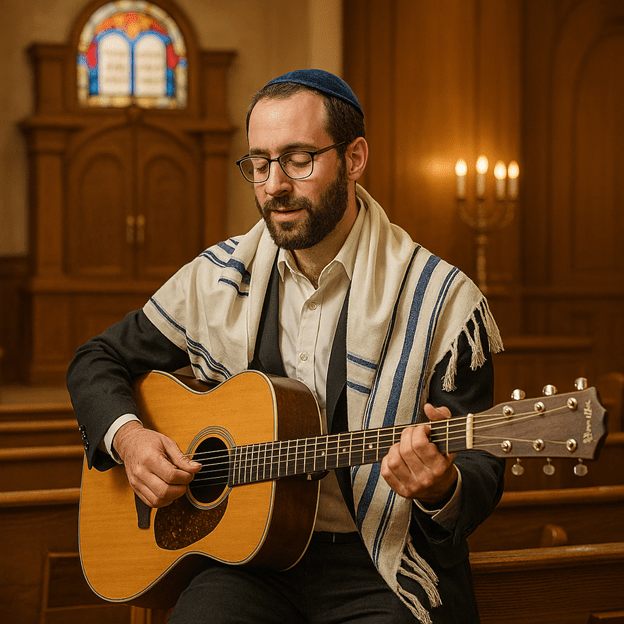
• Finding Harmony: Making Music within your Synagogue

    Bringing Tradition to Life Through Music

    Music is such a profound way to express oneself and a way to connect spiritually with community. Jewish tradition allows for song and prayer. Playing the bass guitar includes keeping time or adding warmth to the rest of your bandmates, but it also includes supporting emotions in a way that is felt, rather than just heard. A true center piece is a piece called Shalom Aleichem. This has not only become a focal point to ending services with a bang, but also a way to welcome the Sabbath and invite peace.

    Instruments in synagogue are about sensitivity and service. And although the guitar and instruments should never overshadow the prayers of the congregation, it is they are a perfect tool to create a supportive foundation. The hope is that it invites and encourages even the most timid to join in worship.

    “Among the many songs woven through the Friday night and Shabbat services, “Shalom Aleichem” holds a special significance. Sung to welcome the Sabbath angels, its melody is familiar across Jewish denominations and cultures”. Making “Shalom Aleichem” the centerpiece of a synagogue guitar collection is both a nod to tradition and an invitation to community participation.

    The beauty of “Shalom Aleichem” lies in its simplicity and adaptability. Multiple melodies exist, ranging from traditional to contemporary, which allows the musician to choose a style that fits the congregation’s preference and energy. The lyrics, invoking peace and divine presence, resonate deeply—especially when paired with the gentle accompaniment of an instrument.

    Playing instruments in synagogue, especially when centering the experience around “Shalom Aleichem,” creates an atmosphere of peace and joy. It bridges generations, inspiring young and old to lift their voices together. By blending tradition with the gentle resonance of guitar, worshipers can find new inspiration and a sense of belonging. The familiar refrain of “Shalom Aleichem” becomes more than just a song—it becomes a heartfelt welcome, a moment of unity, and a musical blessing for the entire community.

    Music has the power to transform and elevate the synagogue experience. When the instruments provide the backdrop to cherished prayers like “Shalom Aleichem,” it strengthens the bonds of community and deepens the sense of peace that defines Shabbat. Whether you are a seasoned guitarist just beginning- or rock out on electric guitar, bass, percussion, or even a saxophone, let your music be an offering—one that invites others to sing, reflect, and welcome peace each week.

  • Meeting God Exactly Where You Are: A Jewish Reflection on Depression

    Depression can make even the simplest acts feel impossible.

    Getting out of bed.

    Returning a text.

    Going to Synagogue.

    Jewish tradition understands the human spirit has what could be compared to as seasons. There is a time for singing, a time for silence, and a time when the only prayer we can offer is the effort to keep going. It is like an ebb and flow.

    Some of us get very down on ourselves when we can’t be 100%. But the beautiful thing is that Judaism doesn’t turn away from this. It actually makes holy space for it.

    There are days when words flow, and days when they do not.

    Judaism honors both. For example:

    • The Amidah can be whispered or thought. The Talmud teaches that even silent prayer rises. If your lips cannot move, your heart still counts.

    • The Shema can be said lying down. Literally. It is the one prayer Jewish law explicitly tells us we may recite “when you lie down and when you rise up”. On the heaviest days, this is a lifeline:

    You can meet God exactly where you are.

    • Tehillim (Psalms) welcomes every emotion. Not just joy and gratitude, but despair, fear, anger, longing.

    “To read a psalm on a low day is to join a lineage of souls who cried out before you.”

    Sometimes prayer is not recited; it is endured. Yet, it still counts. 

    And we can exist peacefully knowing Jewish law does not expect perfection. This can be such a spiritual relief knowing perfection is not demanded.

    “If you cannot pray all the words, say one. If you cannot say one, sit with the siddur open. If you cannot open it, breathe with intention”.

    The Rabbis teach:

    Rachmana liba ba’i – God desires the heart. It doesn’t have to be a unbroken joy or a flawless performance. Just sincerity.

    Depression does not invalidate your tefillah.

    It is your tefillah.

    Amen.

    You do not lose the right to say blessings when joy is dim.

    The morning blessings—for opening the eyes, for standing upright, for giving strength—are not declarations of perfection. They are wishes, reminders, quiet hopes.

    And when they feel false? Judaism teaches that saying them anyway plants seeds. Hillel said, “Where there are no humans, strive to be human.”

    Where there is no hope, sometimes saying a blessing is the effort to reach for hope.

    Kabbalah teaches that every Jewish soul has a spark that cannot be damaged—not by sadness, not by struggle, not by exhaustion.

    It flickers sometimes, but it doesn’t disappear. That is absolutely comforting to learn and hear.

    “Even when you feel numb, your soul is praying. Even when you feel lost, your soul knows its way. Even when you feel empty, your soul remains whole. Depression is a heavy cloak. But beneath it, your light is still alive.”

    Judaism has never demanded constant happiness. It has only asked us to keep moving—one breath, one prayer, one candle, one moment at a time.

    On the days when prayer feels unreachable: the tradition prays for you. On the days when ritual feels too heavy: Its rhythm holds you. On the days when you feel alone: Your ancestors’ voices wrap around you like a tallit of memory.

    You are part of a people who have walked through darkness before.

    You are not walking it alone.

    We are not alone.

  • Mizmor Shir LeYom HaShabbat: A Song for the Day of Rest

    “It is good to give thanks to the Lord, to sing praises to Your name, O Most High; to declare Your steadfast love in the morning and Your faithfulness at night.”

    (Psalm 92:2–3)

    Every week as the sun sets on Friday, Jew ish communities around the world prepare to welcome Shabbat — to bring in peace, light, and a sense of sacred time. Candles are lit, blessings are said, and families gather for a festive meal or head to the synagogue to greet the Shabbat Bride.

    Psalm 92 reminds us that Shabbat is not merely a pause from work — it is a celebration of creation, a moment to see the world through gratitude.

    When I first began my journey toward Judaism, this was one of the hardest ideas for me to grasp. Why do we do this? What is its purpose? And who exactly is the “Shabbat Bride”? I didn’t have those answers right away — but standing in services, hearing the melodies, and joining the community in song felt… right. My rabbi and Cantor often spoke about Shabbat as a time of renewal, a way to begin the week refreshed and grounded. Their words resonated deeply, even before I fully understood them.

    As I learned more, I discovered that menuchah — rest — isn’t about idleness. It’s about spiritual alignment. Psalm 92 teaches that rest is active praise, not absence of effort. “The righteous shall flourish like a palm tree, grow tall like a cedar in Lebanon” (92:13). True rest nourishes the soul. It allows our hearts and minds to expand, to feel restored and rooted once again in what truly matters.

    Through my conversion journey, I’ve come to cherish Shabbat not just as a commandment, but as a gift. Each week it offers me a chance to reset my soul, to step back from the noise of life and remember that God’s order and purpose remain constant, even in uncertain times.

    Shabbat is more than a ritual — it’s an embrace, a reminder of who we are and Whose world we live in.

  • Feeling Alone in your Jewish Journey? You are not alone.

    Judaism has such a long and enduring tradition, and a community that has thrived for years. But we are human and it is common to experience loneliness or isolation in your journey. Feelings of isolation in Judaism can arise from many sources, like being a minority at work, school, feeling like an outsider to your synagogue family, or even family (for those who may have converted to Judaism). It’s a personal, and sometimes, painful experience leaving you feeling lost and/or misunderstood. I know. I’ve been there.

    Let’s turn to our teachings and take a peek at what they say. Going back to my Rabbi’s teaching during the High Holidays, “A person should always be soft like a reed, not hard like a cedar”-Taanit 20a. A great way to put it is that you can bend without breaking, even when you feel out of place. Even though you might be feeling so much emotional pressure, remember to be soft like the reed. You may bend but you won’t break.

    “Just as their faces are not alike, so too their opinions are not alike”-Berachot 58a. This shows individuality is divine. This reaches into the story of Hillel and Shammai. Even when opinions clashed, both were honored. This shows uniqueness is not only acceptable, its designed by G!d.

    There also is the story of Jeremiah. Jeremiah was a lonely prophet, often rejected by his peers, but his voice still mattered, a lot. Jeremiah was mocked and ridiculed for trying to do a good thing and warn his people. His personal feelings are relatable to this because the feelings of personal anguish and isolation, which makes him a symbol of resilience in the face of rejection.

    Jews have faced challenges throughout history and have faced many challenges and periods of isolation. Jewish history as a whole is a testament to resilience and the enduring of the way of the Jewish faith. Our experiences, while unique, are part of a larger continuum of Jewish history and survival.

    If you feel alone in your Jewish faith, please know that you are truly not alone. Others have walked similar paths and found ways to reconnect, grow, and thrive. Seeking community, engaging with tradition, and honoring your personal journey are all valid and meaningful ways to nurture your faith. The Jewish concept of klal Yisrael—the collective people of Israel—reminds us that every Jew is part of a larger whole, even in moments of isolation and solitude.

  • “The primary purpose of prayer is not to make requests. The primary purpose is to praise, to sing, to chant. Because the essence of prayer is a song, and man cannot live without a song. Prayer may not save us. But prayer may make us worthy of being saved.” — Abraham Joshua Heschel

    It’s easy to see prayer as a lifeline—a plea for help when life feels overwhelming. We ask for healing, for clarity, for change. But Heschel’s words offer a deeper, more poetic truth: prayer is not just a request. It’s a song. A praise. A chant. And in that song, we find something far more powerful than a quick fix—we find connection.

    What a beautiful shift in perspective: we don’t need to approach G!d on our knees, begging for mercy. Yes, we are human, and yes, we make pleas. But it’s the act of praising through the storm that carries us through it. Praise is not the absence of pain—it’s the presence of faith.

    This Yom Kippur, between services, I joined a roundtable discussion on the story of Jonah. One question stood out: “How do you relate to Jonah in different parts of the story?” Immediately, Heschel’s quote came to mind. At the end of Jonah’s journey, he’s angry with G!d—frustrated, bitter, pleading. But there’s no praise. No song. No gratitude.

    We pray daily for things to get better. We show up to shul, hoping that traditional prayer will amplify our voice. But deep down, we feel unheard. We wonder if G!d is ignoring us.

    And isn’t that often us?

    I’ve been there. Just recently, I found myself in a situation I desperately wanted G!d to fix—immediately. It was a grueling couple of months. I came to shul with a heart full of demands, not devotion. I was frustrated. I felt invisible.

    But our clergy are wise, and they guide us in ways we don’t always understand. One evening, something shifted. I remembered Heschel’s words. I went to shul not to ask, but to praise. I opened my heart. I sang. I chanted. I let go.

    Two weeks later, everything changed. The situation that had weighed so heavily on me began to lift. I could breathe again. I cried that night—and I’m not a crier. But something in me had transformed. I had taken a meaningful step forward in my Jewish journey.

    So here’s what I’ve learned: don’t approach G!d with a list of demands before you’ve offered your song. Praise first. Let that be your priority. The rest will follow.

  • During Rosh Hashanah services, the Drash centered on a powerful metaphor from the Talmud: the reed and the cedar. The moment I heard it, I was hooked. This ancient imagery carries timeless lessons in resilience and humility—exactly the kind of wisdom I needed to usher in the new year.

    The metaphor contrasts two trees: the reed, which bends with the wind yet stays rooted, and the cedar, which stands tall and rigid but is easily uprooted by strong gusts. It’s a vivid reminder that strength isn’t always about standing firm—it’s often about knowing when to sway.

    As much as I’d love to believe this year will be smooth sailing, I know better. Life brings its share of highs and lows. But the reed teaches us that flexibility and humility are what keep us grounded through it all.

    So here’s the key: stay humble. Be like the reed—bend, don’t break. Or in my words, “just ride the wave” 🤙. That’s how we build true resilience.

    The past few years haven’t been easy. But I’m starting to see that the struggle has shaped me—not into a brittle cedar, but into a reed that knows how to move with the wind. My faith has become my anchor. Attending services, making music for HaShem, and continuing my journey with the Hebrew language so I can study Torah and Talmud—these are the roots that keep me steady.

    Here’s to a new year of growth, humility, and riding the waves with grace!

  • I’ve always wondered why G-d made me quiet. I will say, I’m more outgoing with my synagogue than I’ve ever been. But they would still say I’m quiet. I received this article from my very awesome Clergy member a while ago and wanted to point something’s out as I went back to reread it.

    “Silence isn’t just about not talking. It is about listening with curiosity and openness. By listening from a place of compassion and generosity, we have the power to change the tone and direction of a conversation. Being fully open to another person makes us vulnerable, but it is easier if we recognize that our own vulnerability is what creates a safe place for the other person to be honest. A deeper truth can emerge – even “grow” – from that type of conversation”.

    https://www.sefaria.org/sheets/262960?lang=bi

    Silence isn’t just about not talking. Are you quiet to listen or are you quiet to react? I think sometimes we are so eager to respond and get our point across that we might not be listening to understand the other side. I see it daily, to be honest, but I have seen in a lot in Jewish culture. I think this can be a small reminder for everyone to be purposeful in conversation. Take the time to truly listen, it could really change perspectives for the better and also save relationships.

    Be well.

  • This week we, as a Jewish community, are facing the remembrance of the First and Second Temples that fell in our homeland.  There are so many drashes on this subject, but my Rabbi left me with something to think about Friday night. He, in a nutshell, challenged the congregation to move forward with simplicity. And when you hear that, it sort of doesn’t make sense. Why would I approach such a big atrocity with simplicity? Why would I approach the war with Hamas with…simplicity? But I got to thinking more about it on my 40 minute drive home, and it just sort of clicked. Don’t let this wear you down and leave you defeated. Now more than ever, since WWII, we need to band together as a Jewish population. No matter what denomination, born Jew or converted Jew, male/female/non binary, straight or a part of the LGBTQ community- coming together as one and standing up to hate is what we need. They say we are stronger together, it’s time to prove that. We need prayer, we need more worship, and we need community. So go to your selected synagogue, participate with your fellow Jewish family, and don’t look back. We can do this. Together. 

    I also want to point out how this might fit personally as well. We hear of the story being told of the temples falling. Well what about your story? When something hard happens in your life, how do you want to be remembered? My advice would be to lean on your Jewish faith and find answers in Torah, the Talmud, and prayer. And you know, your Rabbi is usually pretty good at hitting the nail on the head with their drashes, too. 

    In all of this, take a deep breath, put one foot in front of the other, and then lead with simplicity.

    Image from https://barrystrauss.com/fallen-stones-rising-hopes/

  • I just had abdominal surgery and am still of a limited diet. Tisha b’Av starts Saturday night. I can’t do a fast due to my limited diet and medical problems.

    Now, I remember as far back to my Intro to Judaism class that “we live by the rules, we don’t die by them”. Meaning if it’s a medical necessity, you don’t have to fast among other things included in Judaism.

    But, I still feel very guilty. This would be my first fast since I converted and I want to experience all the experience that Judaism has to offer. I lean onto this verse from Ecclesiastes 6:9:

    “Better is the sight of the eyes than the wandering of desire.”

    My desire may take a different meaning than those who are participating. I will cultivate a sense of peace by studying the Torah in this timeframe, guarding myself from envy.

    https://halachipedia.com/index.php?title=Tisha_BeAv
  • Having surgery to remove part of your digestive tract isn’t for the faint of heart. I had been waiting a long time to have this procedure and the time came relatively fast.

    I am so happy with how things are progressing. I have been on a liquid diet since five days before my operation. Needless to say, I’m hungry for solid foods.

    I can’t help how this reminds me of Passover. Now I know it’s not Passover, but I do know that our ancestors were hungry during their voyage.

    What is remarkable is that they never lost faith in following Moses and G!d’s word.

    I am disappointed in myself. What you must know is that I am an open book. you will see spiritual ups and downs as I grow in my journey. This past week I have done great following my diet, but I feel my faith has been shaken a little bit. I wanted the diet to be over, I wanted G!d to head my prayers- and I wanted that to happen NOW, and so many other things to have a negative attitude. This negative attitude wasn’t getting me anywhere.

    But when the Passover thought hit me, it hit hard.

    I’m sure our ancestors were weary, but they leaned on their faith and pressed forward. 

    I’ve prayed and found myself back on the right track. I pray that I allow myself to keep finding strength in HaShem through the hard times. My message to you is that G!d is always there and hears every prayer. Keep the faith.